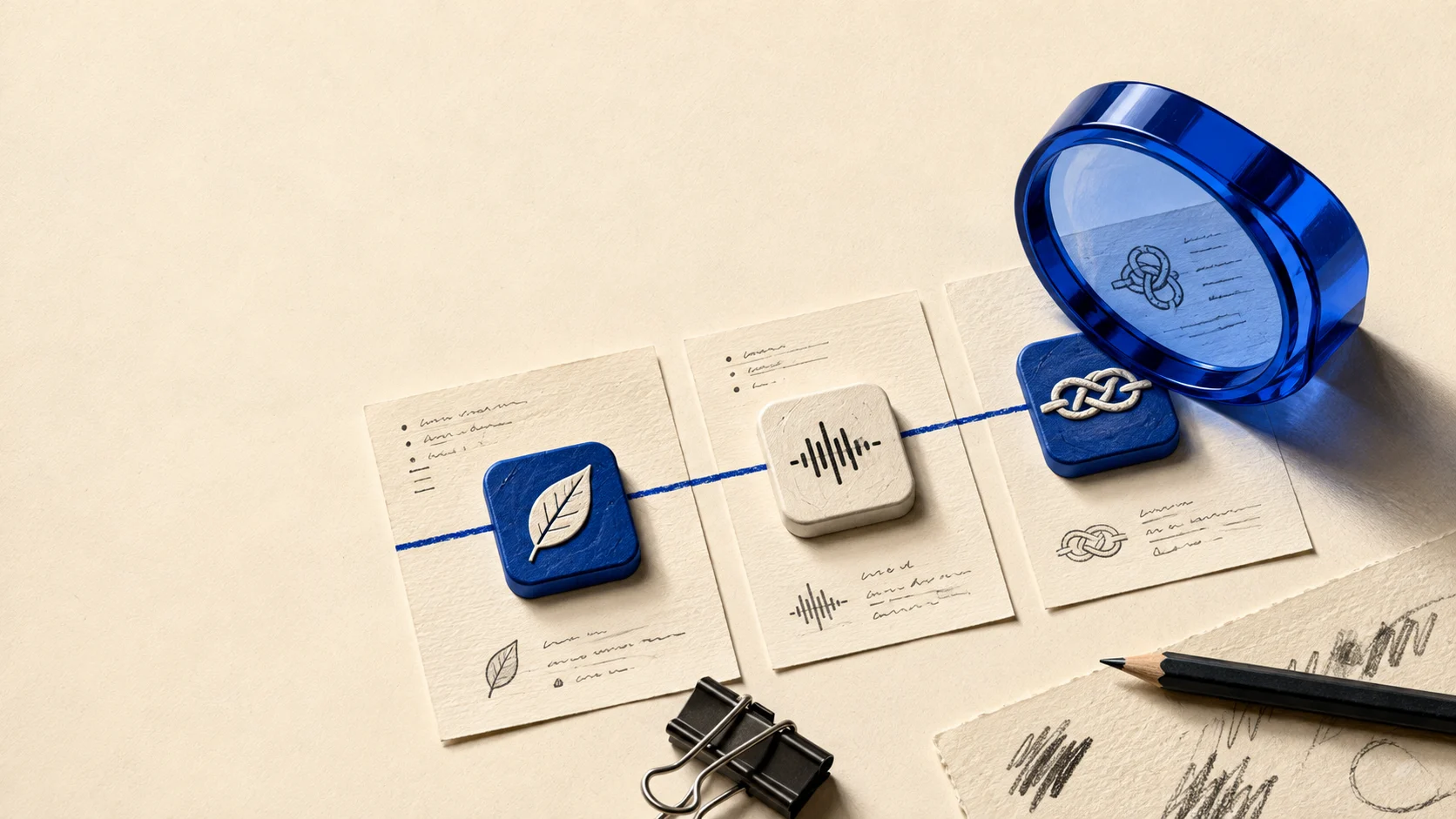
A research notebook can become an excellent hiding place. There are always more apps to inspect and another chart to save. Eventually the collection feels like progress even when no decision has changed.
The exit is a hypothesis with consequences.
Use a sentence with a real user in it
Try: “For people in situation X, result Y will be useful enough that they will do Z.” Z should be an observable action: complete a task, return, switch a workflow or pay under clearly stated terms.
For a hypothetical plant-care tool: “People managing plants in a shared office will use a shared care log because responsibility currently gets lost between colleagues.” That is more testable than “plant apps are popular.”
Attach the evidence and the leap
Under the sentence, write what you actually observed. Perhaps several reviews mention shared responsibility. Then write the leap: you believe this problem is common enough and important enough to justify a separate workflow.
Keeping those two paragraphs separate prevents your interpretation from quietly turning into a fact.
Design the smallest revealing test
A shared document and a reminder may test the workflow before a mobile app exists. Choose participants who encounter the problem, explain the experiment, and decide what you will observe.
Set a time window and a stopping rule before starting. Don’t change the definition of success every time the evidence becomes inconvenient. If people use the log but ignore reminders, that is a finding worth preserving.
Write the next decision in advance
If the result is encouraging, what will you build? If it is weak, what will you change or abandon? An experiment without a decision at the end can become another form of collecting screenshots.
Your hypothesis should be small enough to lose. That makes the next month much less expensive.